

Table of Contents
- Why Resistance Bands Are the Best Home Gym Starter
- Quick Comparison: Top Picks for Beginners
- Resistance Band Levels Explained: Light, Medium, and Heavy
- Loop Bands vs Tube Bands: Which Is Right for You?
- Best Resistance Bands for Beginners at Home: Our Top Picks
- Resistance Band Exercises for Beginners at Home
- Resistance Band Workout for Beginners: A Complete Starter Plan
- How to Stay Safe and Make Your Bands Last
- Frequently Asked Questions
Last Updated: October 8, 2026
Why Resistance Bands Are the Best Home Gym Starter
Resistance bands are the best starter equipment for a home gym: they cost less than a month of most gym memberships, need almost no space, and train every major muscle group without loading your joints like free weights.

The best resistance bands for beginners at home are the ones you will actually pick up when motivation is low: light, joint-friendly, drawer-storable, and set up in ten seconds.
A common mistake is buying the heaviest band because it feels like "real" training. Heavy bands force bad form, strain your shoulders, and land in a closet within a month.
Quick Comparison: Top Picks for Beginners
Here is how our three beginner picks stack up before we break each one down.
| Product | Price | Resistance | Best For |
|---|---|---|---|
| Long Resistance Bands 3 Strengths | $15.99 | 20-40, 40-60, 60-80 lbs | Progressive training |
| Figure 8 Resistance Band | $41.31 | Light, flexible tension | Upper body and posture |
| Foot Pedal Pull Rope with Handle | $24.41 | Multi-tube tension | Seated and full-body work |
All three are one-time purchases with no subscription.

Resistance Band Levels Explained: Light, Medium, and Heavy
Resistance band levels describe how much force it takes to stretch a band, usually listed in pounds. Light (20-40 lbs) suits warm-ups and shoulder work; medium (40-60 lbs) fits curls, presses, and rows; heavy (60-80 lbs) is for mobility work and stronger pulling.
The numbers are a guide, not a rule. A band that feels light for a leg press feels heavy for a lateral raise, because smaller muscles generate less force.
Why the Same Band Feels Different on Every Exercise
A glute bridge recruits your glutes and hamstrings, two of your largest muscle groups. A lateral raise recruits your medial deltoid, a small shoulder muscle.
Band color and stated poundage are starting points, not answers. Two bands labeled "medium" can feel completely different because manufacturers measure resistance at different stretch lengths: one hits 40 lbs at 100% elongation, another at 200%.
A Beginner Decision Framework: Match the Band to the Goal
Before you pick a resistance level, name what you are training for. Most beginners fall into one of four buckets.
- General fitness and strength: Light and medium, enough to make 12-15 reps challenging on the last two without breaking form. A three-level set covers this best.
- Mobility and stretching: Light only. Mobility is about range of motion, not load; a heavy band pulls you out of the position you are improving.
- Rehabilitation and joint-friendly training: Light to medium, erring lighter. The goal is controlled tension through a pain-free range, not fatigue. A physical therapist can tell you which movements are appropriate.
How to Progress Resistance Without Guessing
Progression with bands works differently than with dumbbells, you cannot add 5 lbs. You have three levers:
- Move up a level. When all sets at 15 reps feel easy on the last two, switch to the next band up.
- Increase stretch. Anchor the band further away or step wider so it is under tension at the start.
- Slow the tempo. A three-second lowering phase on a band row turns a light band into a much harder exercise, the most underused lever, and it costs nothing.
A practical rule: 20 clean reps means too light; form breaking before rep 8 means too heavy. The sweet spot is 12-15 reps where the last two are a genuine effort but technique holds.
What to Buy First
For most beginners, a set with light, medium, and heavy is the cheapest way to avoid reordering in three weeks. Our Long Resistance Bands 3 Strengths set covers all three for $15.99, less than buying them one at a time. If you only want one band, buy light, you can add resistance with stretch and tempo, but you cannot make a heavy band lighter.
Loop Bands vs Tube Bands: Which Is Right for You?
Loop bands are continuous circles of elastic; tube bands are cords with handles or clips. Loops work best for glutes, hips, and lower-body activation because you step into them. Tube and handled versions suit upper-body pulling and pressing. Neither is "better", most beginner setups end up with one of each. The practical difference:
- Loop bands: step-in access, great for glute bridges, lateral walks, and squat activation
- Tube bands with handles: better grip comfort for rows, presses, and chest work
- Foot pedal pull ropes: tube-style bands with a foot loop for seated and anchored movements
If you can only buy one, match it to your goal. Want stronger glutes and hips? Loop. Want arms, back, and posture? Handled or figure-8.

Best Resistance Bands for Beginners at Home: Our Top Picks
Our top pick for most beginners is the Long Resistance Bands 3 Strengths set: three resistance levels in one purchase means you can grow without buying again, and it is the cheapest way to cover light, medium, and heavy in one order.
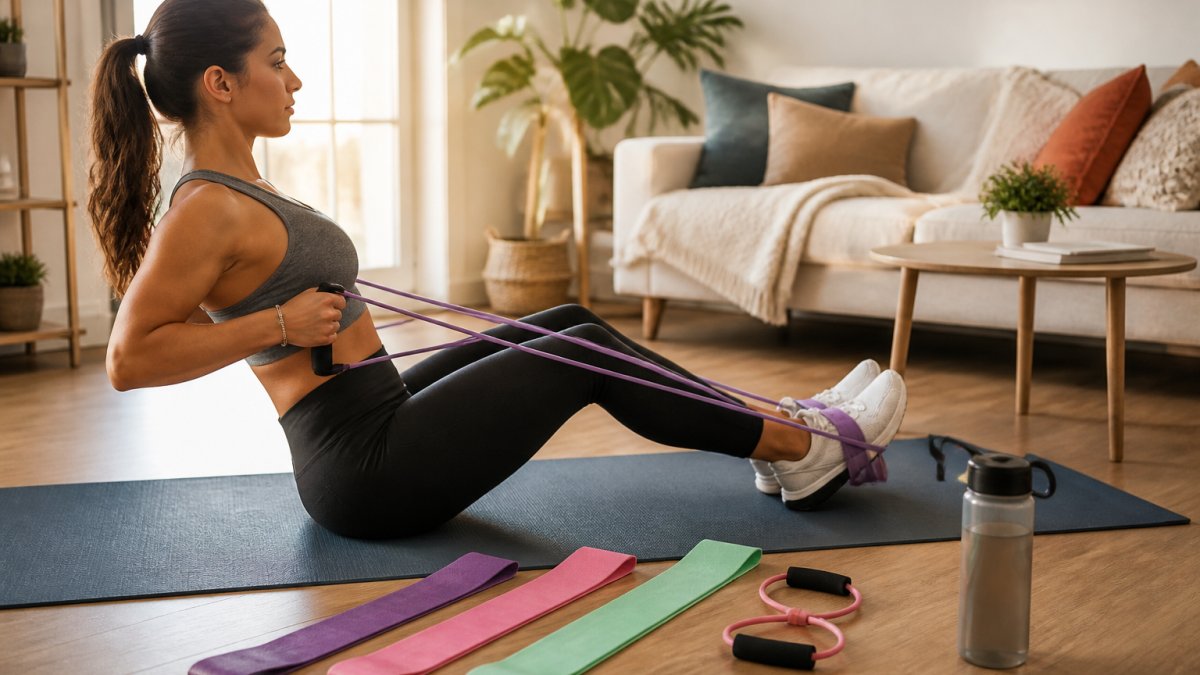
Long Resistance Bands 3 Strengths: Best for Progressive Training
Price: $15.99
This set gives you three long fabric bands: heavy (60-80 lbs), medium (40-60 lbs), and light (20-40 lbs).
What works: Three levels in one purchase means you are not guessing which single band to buy.
What doesn't: Long bands need an anchor point or your own hands and feet for most movements, so they are less grab-and-go than a figure-8.
Figure 8 Resistance Band: Best for Upper Body and Posture
Price: $41.31
The figure-8 shape fits your hands and body naturally, making it the most comfortable option here for arm, back, and shoulder work.
Long Resistance Bands 3 Strengths Purple, Pink and Green →
What works: The ergonomic grip reduces hand fatigue, which matters if you are doing high-rep arm work.
What doesn't: It is the most expensive pick here, and the light tension is not built for heavy pulling.
Foot Pedal Pull Rope with Handle: Best for Seated and Full-Body Workouts
Price: $24.41
This one uses four natural latex pull tubes with a foot pedal and foam handles. The four-tube design gives higher tensile strength than two-tube versions, and the handles are shaped to fit your hand.
What works: The foot pedal lets you train seated, which most bands cannot do well.
What doesn't: Four tubes mean more to keep tidy, and the setup is slightly slower than a single loop.
Resistance Band Exercises for Beginners at Home
The best resistance band exercises for beginners at home mirror basic human movement: pushing, pulling, squatting, and hinging. Six cover almost everything:
- Band rows (medium): anchor the band, pull toward your ribs, squeeze your shoulder blades
- Chest press (medium): loop the band behind your back, press forward until arms straighten
- Glute bridges (light loop or long band): press hips up against the band's tension
- Lateral walks (light loop): step side to side with the band around your thighs
- Shoulder press (light): stand on the band, press handles overhead
- Bicep curls (medium): stand on the band, curl handles toward your shoulders
Do 2-3 sets of 12-15 reps each. Rest 45 to 60 seconds between sets. That is a full workout.
Resistance Band Workout for Beginners: A Complete Starter Plan
A good resistance band workout for beginners runs three days a week with a rest day between sessions, about 20 minutes each, enough to build strength without overwhelming a new routine.
Sample 20-Minute Full-Body Routine
Warm up for two minutes with arm circles and light band stretches. Then run this circuit twice:
| Exercise | Reps | Band Level | Rest |
|---|---|---|---|
| Band rows | 12-15 | Medium | 45 sec |
| Chest press | 12-15 | Medium | 45 sec |
| Glute bridges | 15 | Light | 45 sec |
| Lateral walks | 10 steps each way | Light | 45 sec |
| Shoulder press | 12 | Light | 45 sec |
| Bicep curls | 12-15 | Medium | 45 sec |
Finish with two minutes of stretching. Move up to the heavy band only when the medium feels easy across all sets. In a small apartment, keep the whole setup in one drawer: long bands, figure-8, and foot pedal rope, no rack or bench required beyond a yoga mat.
How to Stay Safe and Make Your Bands Last
Resistance bands are among the safest home equipment you can buy, but they store energy when stretched. Most band injuries come from three causes: a worn band that snaps, an anchor that gives way, or a movement the user was not ready for, all preventable with a short pre-workout routine.
The 60-Second Pre-Workout Band Check
Do this before every session, not just when a band looks old.
- Run your hands along the full length. Feel for nicks, thin spots, cloudy patches, or soft areas. Latex and fabric weaken over time, and wear shows up as a small defect before it becomes a tear.
- Hold it up to the light. Cracks and thinning are easier to see against a bright background. Anything like a cut or dry patch means retire the band.
- Check the handles and clips. On tube bands, look where the tube meets the handle or clip, that junction takes the most stress.
Anchoring: What Works and What Does Not
The safest anchors are your own body weight (standing on the band, looping it around a foot) and purpose-built door anchors that sit in the hinge side of a closed door.
What not to anchor to:
- Door handles. Designed to be pulled sideways, not straight out; they can fail or pull free.
- Shelves, hooks, and picture hangers. Not rated for repeated dynamic load.
- Anything that could tip. A chair, lamp, or small table. If it can move, it will.
If you do not have a safe anchor, you do not need one. Rows, presses, squats, and glute bridges can all be done with your own hands and feet as the anchor, which is why bands work so well in small apartments.
Common Beginner Mistakes
- Starting too heavy. The most common mistake. Heavy bands force bad form, strain your shoulders, and land in a closet within a month. Start lighter than you think you need.
- Skipping the warm-up. Two minutes of arm circles and light band stretches raises tissue temperature and lets you feel the band before you load it.
- Overstretching the band. Never stretch a band past roughly three times its resting length, beyond that you are testing the material, not training your muscles.
Storage and Longevity
How you store a band matters as much as how you use it. Latex and fabric break down faster from heat, sunlight, and oils than from training.
- Keep bands out of direct sunlight. UV light degrades elastic. A drawer or closed bin beats a sunny windowsill.
- Avoid heat. Do not leave bands in a hot car or near a radiator.
- Wipe handles after sweaty sessions. Salt and oils break down foam and grip material.
With basic care, a good beginner set lasts a long time, low cost, low risk, easy to replace. A three-level set for $15.99 means replacing one worn band is a minor cost, not a reason to abandon your routine.
Frequently Asked Questions
What are the best resistance bands for fitness?
The best resistance bands for beginners are versatile sets that offer multiple resistance levels, such as the Long Resistance Bands 3 Strengths from JordanWellnessCo. This set includes light (20-40 lbs), medium (40-60 lbs), and heavy (60-80 lbs) bands, allowing you to progress as you get stronger. Look for durable fabric or latex construction and a comfortable grip, and consider whether you prefer loop bands, tube bands with handles, or figure-8 bands for your specific goals.
Is resistance band training good for beginners?
Yes, resistance band training is excellent for beginners. Bands are joint-friendly, portable, and provide adjustable resistance that lets you start light and progress gradually. They are effective for building strength, improving mobility, and supporting rehabilitation. A beginner can perform a full-body workout with just a few bands, making them a cost-effective and space-saving alternative to free weights. Start with light resistance and focus on proper form before increasing tension.
What resistance level should a beginner choose?
Beginners should start with light resistance, typically 20-40 lbs of tension, to learn proper form and avoid strain. A set with multiple levels, like the Long Resistance Bands 3 Strengths, is ideal because it includes light, medium, and heavy options. Begin with the light band for upper-body exercises and the medium band for lower-body movements. As you complete 12-15 reps comfortably, move up to the next level. Always warm up first and prioritize controlled movements over heavy resistance.
Are resistance bands enough for a full-body workout?
Yes, resistance bands can provide a complete full-body workout. You can target your upper body (chest presses, rows, shoulder presses), lower body (squats, lunges, glute bridges), and core (wood chops, seated rows) with different bands. The key is to use varying resistance and exercise variety. A 20-minute routine combining loop bands and tube bands can work all major muscle groups. For best results, combine band training with bodyweight exercises and aim for 2-3 sessions per week.
How do beginners use resistance bands safely at home?
To use resistance bands safely at home, inspect them before each use for nicks, tears, or weak spots, and discard damaged bands immediately. Anchor them securely to a sturdy object or door, and never stretch a band beyond its recommended length. Maintain good posture and avoid locking your joints. Start with light resistance and focus on slow, controlled movements. If you have any health concerns, consult a qualified professional before starting a new exercise program.


