

Table of Contents
- Quick Comparison: 7 Fitness Routines at a Glance
- How to Start Healthy Habits Without Overhauling Your Life
- How Long Should a Workout Be for Beginners?
- The Best Fitness Routines for Every Goal
- Building Your Routine Around Your Age and Recovery
- Best Fitness Gear for Home Workouts
- Common Mistakes That Derail Even Good Routines
- Frequently Asked Questions
Last Updated: September 13, 2026
Quick Comparison: 7 Fitness Routines at a Glance
The best fitness routines are the ones you will actually repeat next week. This guide from JordanWellnessCo breaks down seven proven plans, from three-day full-body strength to equipment-free home sessions, so you can match one to your schedule, goal, and recovery. Most people fail because the plan demanded more time than their life allowed, a routine that fits beats a perfect one that doesn't.
| Routine | Days/Week | Best For | Equipment Needed |
|---|---|---|---|
| Full-Body Strength | 3 | Beginners, busy schedules | Dumbbells or bands |
| Upper/Lower Split | 4 | Intermediate lifters | Full gym or home rack |
| Push/Pull/Legs | 5-6 | Advanced, high volume | Full gym |
| Cardio-First | 4-5 | Heart health, endurance | Jump rope, treadmill |
| Home-Based Minimal | 3-4 | Travel, small spaces | Resistance bands |
| Age-Adjusted Strength | 3 | 50+, joint care | Light weights, bands |
| Hybrid Walk-and-Lift | 4 | Fat loss, general health | Walking pad, dumbbells |
How to Start Healthy Habits Without Overhauling Your Life
Learning how to start healthy habits comes down to shrinking the habit until it's almost impossible to skip. Anchor one new behavior to something you already do daily, then add load only after the habit holds for two weeks.
The mistake most people make is treating motivation as a prerequisite. It isn't. Consistency comes from lowering the activation cost: shoes by the door, bands on the coffee table, a workout at the same hour.

How Long Should a Workout Be for Beginners?
A beginner workout should run 30 to 45 minutes, including a warm-up and cool-down. Sessions longer than an hour rarely improve results for new lifters and increase the odds of quitting.
Here's how to split that time:
- Warm-up: 5-10 minutes of light cardio and mobility work
- Main work: 20-30 minutes of strength or cardio at moderate intensity
- Cool-down: 5 minutes of stretching and breathing
Beginners progress faster on three short sessions per week than two long ones, frequency matters more than session length early on.
The Best Fitness Routines for Every Goal
Choosing among the best fitness routines means matching training frequency, rep ranges, and rest intervals to your goal. Strength, hypertrophy, and cardiovascular endurance each respond to different set volume and rest periods, and the routines below are built around that principle. Each includes a weekly template, a progression rule, and a no-equipment fallback, routines usually fail not because they were wrong, but because the gym closed, the trip happened, or the bands got lost.
1. Full-Body Strength Routine (3 Days a Week)
Best for beginners and anyone with a packed calendar. Three sessions, each hitting every major muscle group with compound movements.
Weekly template (e.g., Monday / Wednesday / Friday):
- Squat or goblet squat: 3 sets of 5-8 reps
- Push-up or bench press: 3 sets of 5-8 reps
- Row or band pull: 3 sets of 8-12 reps
- Hip hinge (deadlift pattern): 3 sets of 5-8 reps
- Plank or farmer carry: 2-3 sets
Rest 2-3 minutes between heavy sets. Progressive overload is simple: add a small amount of weight or one rep each week. When you hit the top of the rep range on every set for two sessions in a row, add load.
No-equipment fallback: Replace the squat with a tempo bodyweight squat (3 seconds down), the row with a doorway or towel row, and the hinge with a single-leg glute bridge. Same sets and reps.
2. Upper/Lower Split (4 Days a Week)
Two upper-body days, two lower-body days. This split suits intermediate lifters who want more set volume per muscle group without living in the gym.
Weekly template (e.g., Mon / Tue / Thu / Fri):
- Upper A: horizontal push (bench or push-up), horizontal pull (row), vertical push (overhead press), vertical pull (pull-up or lat pulldown), plus 2 accessory movements
- Lower A: squat pattern, hinge pattern, calves, core
- Upper B: same categories, different exercise variations (incline press, chin-up, etc.)
- Lower B: same categories, different variations (front squat, Romanian deadlift, etc.)
Rest 90 seconds to 2 minutes to keep each session under an hour, and aim for 10-16 working sets per muscle group per week, steady progress without accumulating joint stress.
No-equipment fallback: Run the same A/B structure using push-up variations (incline, standard, decline, archer) and single-leg squat progressions. Volume stays the same; only the load source changes.
3. Push/Pull/Legs (5-6 Days a Week)
A high-frequency split for advanced trainees. Push days cover chest, shoulders, and triceps. Pull days cover back and biceps. Leg days cover quads, hamstrings, glutes, and calves.
Weekly template (e.g., Push / Pull / Legs / Push / Pull / Legs / Rest):
- Push: 1 heavy compound press, 1 secondary press, 2-3 isolation movements
- Pull: 1 heavy row or pull-up, 1 secondary pull, 2-3 isolation movements
- Legs: 1 squat pattern, 1 hinge pattern, 1 unilateral movement, calves, core
This plan only works with genuine recovery: sleep, protein, and at least one full rest day. Run it 6-8 weeks, then deload by halving weekly volume for one week.
No-equipment fallback: Collapse to a 4-day upper/lower structure using bodyweight progressions. The push/pull/legs split assumes you can load heavy enough to justify the frequency; without equipment, that assumption breaks.
4. Cardio-First Routine for Heart Health
Four to five sessions per week mixing moderate and vigorous intensity. The goal is cardiovascular endurance, not muscle size.
Weekly template:
- Two steady-state sessions: 30-40 minutes at moderate intensity (you can talk but not sing)
- Two interval sessions: 20 minutes alternating hard and easy efforts (a common pattern is 30 seconds hard, 90 seconds easy)
- One long session: 45-60 minutes at an easy pace
A jump rope works well for intervals because it raises heart rate fast in small spaces. Department of Health and Human Services guidance recommends at least 150 minutes of moderate-intensity aerobic activity per week for adults, which this template exceeds.

No-equipment fallback: Substitute brisk walking, stair climbs, or shadow boxing for the jump rope. The interval structure matters more than the modality.
5. Home-Based Routine With Minimal Equipment
Three to four sessions per week using resistance bands and body weight, the routine for travelers, small apartments, and anyone who wants zero commute.
Weekly template:
- Band squats and band rows: 3 sets each
- Push-ups (incline, standard, or decline): 3 sets
- Band overhead press and lateral raises: 3 sets
- Split squats and glute bridges: 3 sets
- Core circuit: 3 rounds
Bands make progressive overload straightforward: move to a heavier band, slow the tempo, or shorten rest, any one keeps adaptation going for several weeks.
No-equipment fallback: Drop the bands entirely and use isometric holds (wall sits, plank variations, hollow holds) plus tempo bodyweight movements. This is the routine that survives a hotel room with no gear at all.
6. Hybrid Walk-and-Lift Routine (4 Days a Week)
Two strength days and two walking-focused days, plus optional daily steps, for people whose primary goal is fat loss and general health rather than maximal strength or endurance.
Weekly template:
- Two full-body strength sessions (30-40 minutes, compound-focused)
- Two 30-45 minute walking sessions at an incline or brisk pace
- Daily step target of 7,000-10,000 steps, accumulated however fits your day
The strength work preserves muscle while the walking adds energy expenditure without the recovery cost of running, making this more sustainable for beginners than a pure cardio plan.
No-equipment fallback: Already equipment-free. A walking pad or treadmill with incline is optional; outdoor walking works identically.
How to Pick Between These Six
- If you have never trained consistently: start with Full-Body Strength.
- If you have 6-12 months of lifting experience: Upper/Lower Split.
- If you have 2+ years and sleep well: Push/Pull/Legs.
- If heart health is the priority: Cardio-First.
- If you travel or have limited space: Home-Based Minimal.
- If fat loss is the priority and you dislike intense cardio: Hybrid Walk-and-Lift.
Run whichever you choose for at least 6-8 weeks before switching. Program hopping is the single most common reason people report that "nothing works."
Building Your Routine Around Your Age and Recovery
Most fitness guides treat age as a footnote. It isn't. Recovery capacity, joint tolerance, and hormonal environment all shift across decades, and a routine that ignores those shifts tends to produce nagging injuries rather than results. Training age still matters more than birthday, but the decade-by-decade adjustments below are a useful starting frame.
In Your 20s
Recovery is at its peak, making this the decade to build the strength base that carries you through the next 30 years. Most people in their 20s can tolerate 4-6 training days per week, including two-a-days if sleep and nutrition support it.
- Prioritize compound lifts and progressive overload while joints tolerate heavy loading well
- A 4-6 day split (upper/lower or push/pull/legs) is realistic
- Warm-ups can be shorter, 5-8 minutes is usually enough
- The main risk is ego-driven programming: too much volume, too little sleep, and skipping deloads
In Your 30s
Recovery is still strong but career and family demands compress training time. The adjustment is not less training, it's more efficient training.
- 3-4 days per week of full-body or upper/lower work fits most schedules
- Keep compound lifts, but add 5-10 minutes of mobility work before sessions
- Rest intervals may need to stretch to 2-3 minutes on heavy sets to maintain output
- Sleep debt is the biggest hidden variable; a 30-something sleeping 5 hours a night cannot run the same volume as a 20-something sleeping 8
In Your 40s
This is where joint care starts to matter as much as muscle load. Tendons and connective tissue adapt more slowly than muscle, so sudden jumps in volume or intensity carry more risk.
- 3-4 training days per week, with at least one full rest day between heavy lower-body sessions
- Warm-up extends to 10-12 minutes, including dynamic mobility for hips, shoulders, and ankles
- Shift some barbell volume toward dumbbells, machines, or bands to reduce joint stress while keeping the stimulus
- Add one dedicated mobility or low-intensity session per week (walking, swimming, yoga)
In Your 50s and Beyond
Muscle mass declines from midlife onward if not actively trained, and bone density becomes a meaningful consideration. Strength training is not optional here, it is the primary tool for maintaining independence.
- 3 strength sessions per week, each 30-45 minutes, is the sweet spot for most people
- Warm-up of 10-15 minutes, including balance work (single-leg stands, heel-to-toe walks)
- Slightly longer rest intervals between heavy sets, 2-3 minutes, to allow full recovery
- Prioritize compound movements while joints tolerate them, then shift volume toward machines and bands
- Add one extra rest day per week rather than pushing through soreness
- Include at least two sessions per week of weight-bearing activity for bone health
The Two Adjustments That Pay Off in Every Decade
Regardless of age, two changes produce outsized returns:
- Add one rest day before you think you need it. Most people add rest only after an injury. Adding it proactively costs one session and prevents weeks off.
- Track recovery, not just performance. Sleep hours, resting heart rate, and how you feel on the first set of the day are better indicators of whether to push or back off than any training log.
A Note on Recovery Beyond Age
Age is one input among several. Stress, sleep quality, nutrition, and training history all influence how much work you can absorb in a given week. A 30-year-old with a newborn and a 55-year-old with a stable routine may recover at similar rates. Use the decade guidance as a starting point, then adjust based on how you feel and perform across two to three weeks.
Best Fitness Gear for Home Workouts
The best fitness gear for home workouts is whatever removes friction between you and the first rep. Most home setups need three things: something to add resistance, something to raise your heart rate, and something to protect your joints.
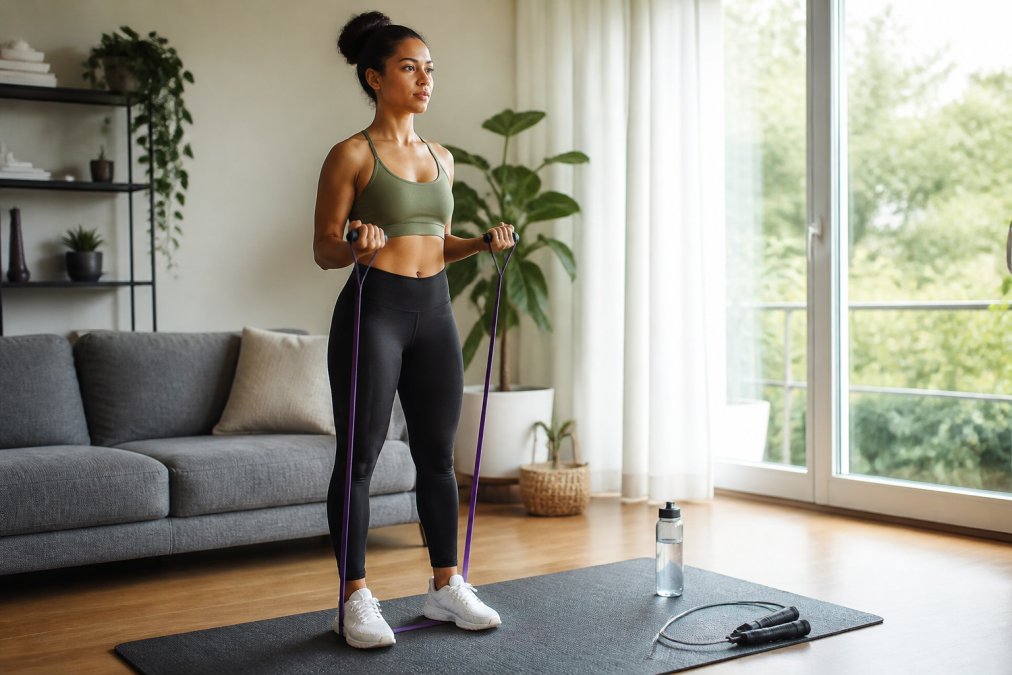
Resistance bands cover strength work in a drawer-sized space. A jump rope covers cardio intervals in about the same footprint. A walking pad handles low-impact steady-state sessions while you work.

JordanWellnessCo is your all-in-one e-commerce destination, empowering you to live healthier every day by offering a curated selection of supplements, fitness gear, personal care, skincare, and self-care essentials. We provide the tools you need to train with purpose and breathe better, supporting your journey toward holistic well-being. Our wide range of products makes us a unique one-stop shop for anyone looking to enhance their fitness routine or elevate their personal care regimen. Discover everything you need to feel your best, all in one inviting and supportive place. The Adjustable Jumping Rope at $12.99 covers interval work. The Long Resistance Bands set at $15.99 gives you three strengths for progression. For steady-state cardio, the Walking Pad Treadmill at $239.80 adds an incline without a gym membership.
For lifters adding load, the MRX Weight Lifting Gloves at $15.99 protect your hands during heavy pulling work.
Common Mistakes That Derail Even Good Routines
The most common mistake is changing the plan before it has had a chance to work. Hypertrophy and cardiovascular endurance both adapt on a timescale of weeks, not days.
Other frequent problems:
- Skipping the warm-up, then wondering why the first set feels terrible
- Training to failure on every set and burning out by week three
- Ignoring rest intervals, which turns a strength session into accidental cardio
- Adding volume instead of adding load when progress stalls
Frequently Asked Questions
What is the most effective exercise routine?
The most effective routine is one you can stick with consistently. Research shows that a mix of aerobic activity and strength training produces the best results for overall health. Aim for at least 150 minutes of moderate-intensity cardio per week plus two full-body strength sessions. The best fitness routines combine compound movements, progressive overload, and enough recovery to avoid burnout. Consistency beats intensity every time.
How do I build a consistent fitness routine that sticks?
Start smaller than you think you need to. Commit to two 20-minute sessions per week instead of five 60-minute ones. Schedule workouts at the same time each day, track your progress visibly, and tie the habit to something you already do (like walking after your morning coffee). When you learn how to start healthy habits this way, you build momentum instead of relying on motivation.
How much exercise does the Physical Activity Guidelines for Americans recommend?
The Physical Activity Guidelines for Americans recommend at least 150 minutes of moderate-intensity aerobic activity or 75 minutes of vigorous-intensity activity per week, plus muscle-strengthening activities on two or more days per week. You can split this into shorter sessions throughout the day. Even 10-minute blocks count toward the weekly total, which makes it easier to fit movement into a busy schedule.
Can I see results with a 30-minute daily fitness routine?
Yes. A 30-minute daily routine that includes both strength training and aerobic activity can improve cardiovascular endurance, body composition, and metabolic rate. The key is intensity and consistency. Use compound movements, keep rest intervals short, and progressively increase training load. For beginners, 30 minutes is often the sweet spot for how long a workout should be, since it's long enough to be effective without causing excessive fatigue.
What is the best fitness gear for home workouts?
You don't need much to start. A set of resistance bands, an adjustable jump rope, and a pair of weight lifting gloves cover most home routines. If you're short on space, a walking pad treadmill with an incline lets you get cardio without leaving the house. Add a weighted vest for progressive overload once bodyweight exercises feel easy. JordanWellnessCo carries all of these, and they work together as a complete home setup.
The hardest part of fitness isn't picking a plan. It's having the gear ready when the plan says it's time to train. JordanWellnessCo carries the resistance bands, jump ropes, walking pads, and lifting accessories that keep a routine running, all in one place, so you're not waiting on three shipments to start week one. Get started with JordanWellnessCo and build the routine you'll still be running in six months.


