

Table of Contents
- The Only Fitness Gear You Actually Need to Start
- How to Build a Home Gym on a Budget
- Benefits of Using Resistance Bands for Beginners
- How to Choose the Right Yoga Mat
- Cardio Gear for Small Spaces
- Your First Fitness Tracker: What Actually Matters
- Gear You Can Skip (For Now)
- Making It Last: Simple Care Tips
- Frequently Asked Questions
Last Updated: September 24, 2026
The Only Fitness Gear You Actually Need to Start
Most beginners buy too much gear and quit anyway. The essential fitness gear for beginners fits in a single duffel bag and costs less than a month of a big-box gym membership. Most beginners buy too much gear and quit anyway. The essential fitness gear for beginners fits in a single duffel bag and costs less than a month of a big-box gym membership.
Match Your Gear to Your Space, Not the Other Way Around
Your living situation decides your equipment list, not the other way around. A studio apartment and a garage call for completely different purchases, and buying for the wrong one wastes money. Measure your floor space first, then shop.

How to Build a Home Gym on a Budget
The cheapest home gym is not the one with the most equipment, it is the one you will actually use every week. Buy one versatile tool at a time and add only when your current gear stops challenging you.
Set a Number Before You Set a List
Most beginners fail at budgeting because they shop by category instead of by cap. Pick a total for your first 90 days, many beginners land between $50 and $150, and treat it as a ceiling, not a target. Then buy in tiers.
The $50 Starter Kit That Covers 80% of Your Workouts
You can cover most beginner training with three items that cost less than a single personal training session. At JordanWellnessCo, our Resistance Bands Sealing Elastic Booty Sport Bodybuilding Rubber Band run $9.33 with four tension levels from 10 to 40 pounds. Add the Adjustable Jumping Rope at $12.99, and strength and conditioning are covered for under $25.

| Gear | Price | What It Covers | Space Needed |
|---|---|---|---|
| Resistance Bands | $9.33 | Strength, mobility, warmups | Drawer |
| Adjustable Jumping Rope | $12.99 | Cardio, intervals, coordination | |
| Fitness Equipment for Beginners (Paperback) | $10.76 | Form, safety, programming | Bookshelf |
How to Decide What to Buy Next
Use one rule: upgrade when your current gear stops challenging you, not when a sale pops up. If your lightest band no longer feels hard on a full set of rows, you have earned the next tension level. If bodyweight squats still leave your legs shaking, you have not earned a barbell.

Benefits of Using Resistance Bands for Beginners
Resistance bands are the single best first purchase for most beginners: cheap, portable, joint-friendly, and they scale as you get stronger. Unlike fixed-weight dumbbells, bands let you adjust tension by changing your grip or stance.
The main benefits for beginners:
- Low joint stress: Bands load your muscles without the compression that heavy weights put on knees and shoulders.
- Portability: A set fits in a gym bag or carry-on, so travel never breaks your routine.
- Progressive overload: Move your hands closer together or step further from the anchor to increase difficulty.
- Versatility: Use them for strength training, mobility work, and warmups in the same session.
How to Pick Your First Set
Match band tension to your current strength, not your goals. A beginner who can barely complete ten bodyweight squats does not need the heaviest band in the pack. Start with the lightest level and progress only when it feels easy for a full set.
How to Choose the Right Yoga Mat
The right yoga mat comes down to three things: thickness, grip, and material. Thickness affects comfort and stability, grip affects safety during sweaty sessions, and material affects durability and feel.
Cardio Gear for Small Spaces
Cardio equipment is where beginners overspend most. A full treadmill eats floor space and collects dust once the novelty wears off. Compact options deliver the same cardiovascular health benefits in a fraction of the footprint.
Fitness Equipment for Beginners: How →
The best small-space cardio tools:
- Jump rope: Burns serious calories, stores in a pocket, costs under $15.
- Walking pad: Fits under a desk or sofa and lets you walk during calls or shows.
- Vibration plate: Uses oscillation to activate muscles and includes resistance bands for full-body work.
Your First Fitness Tracker: What Actually Matters
A fitness tracker is worth buying only if it changes your behavior. For beginners, the features that matter are step counting, heart rate, and sleep tracking. Everything else is optional until your routine sticks.
What to prioritize in a first tracker:
- Battery life: A watch you charge daily becomes a watch you stop wearing.
- Comfort: A bulky case on a small wrist gets left in a drawer.
- The basics: Steps, heart rate, and sleep beat a long list of unused features.
Gear You Can Skip (For Now)
Most beginner gear lists are too long, and that length is the problem: every extra purchase adds a decision, a storage spot, and a reason to feel behind. But 'skip it' is not 'never buy it.' The gear below is not bad, just premature. Here is what to skip and the signal that tells you it is time to buy.
- Adjustable dumbbells and kettlebells: Bands cover the same pushing and pulling patterns for less money and a fraction of the space. Buy when: your heaviest band feels easy for a full set of 12 reps on two or more exercises.
- Weight bench and squat rack: These unlock heavier loading, but only if you already have a consistent routine to load. Buy when: you have trained three or more times a week for two straight months without missing a week.
- Lifting straps and grip gloves: Useful at heavy loads, unnecessary at beginner weights, and they can mask a weak grip you actually want to build early. Buy when: your grip fails before your back or legs do on pulling movements.
- Barbell and weight plates: These need a rack, a platform, and real commitment. They are the single most abandoned purchase in home gyms. Buy when: you have outgrown adjustable dumbbells and can name the specific lifts you cannot progress without a bar.
- A full cardio machine: A treadmill or elliptical is the largest, heaviest thing a beginner buys and the fastest to collect dust. Buy when: you have used a jump rope or walking pad consistently for 8-12 weeks and still want more.
The Upgrade Rule That Beats Any Gear List
Every item above has a trigger, and it is always the same shape: your current gear stops challenging you, and you can name a specific movement you cannot progress without the upgrade. That is progressive overload applied to shopping, not just training.
Making It Last: Simple Care Tips
Equipment that lasts is equipment you maintain. A few habits keep your gear working for years.
- Wipe resistance bands with a damp cloth after sweaty sessions and store them out of direct sunlight. UV degrades rubber over time.
- Check jump rope handles and cable connections monthly for fraying.
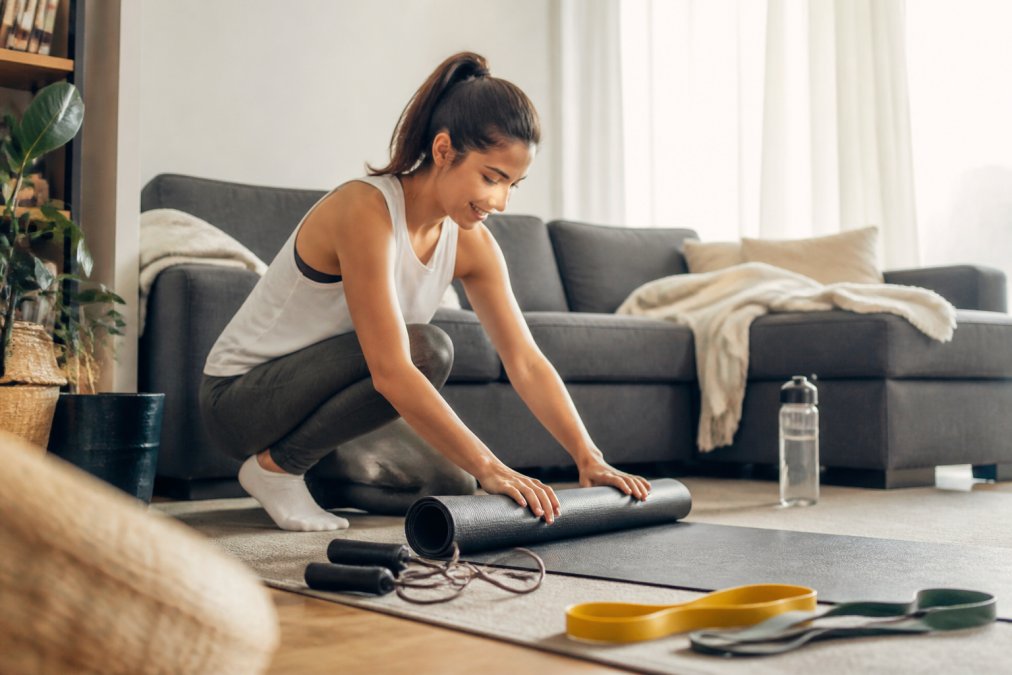
- Roll your mat instead of folding it. Folds create creases that weaken the surface and trap dirt.
- Keep a small repair kit in your gym bag: a spare band, tape, and a cloth.
- Store everything in one place. A dedicated bin or shelf makes setup fast and prevents gear from scattering.
Frequently Asked Questions
What fitness equipment is best for beginners to start with at home?
Start with three items: a set of resistance bands, an adjustable jump rope, and a yoga mat. Resistance bands cover strength training for every major muscle group, the jump rope handles cardio in a tiny footprint, and the mat supports mobility work and floor exercises. This trio costs under $40 total and covers 80% of a beginner workout routine. Add a fitness tracker or adjustable dumbbells later once you know your routine will stick.
Do I need expensive equipment to start a fitness routine?
No. The most common mistake beginners make is buying a $1,000 home gym setup before completing a single week of workouts. Start with gear that costs less than $50 total: resistance bands ($9.33), a jump rope ($12.99), and a yoga mat. These cover strength, cardio, and recovery. Once you have trained consistently for 4-6 weeks, you will know exactly what to add next, and you will have earned the right to spend more.
How do I choose the right resistance bands for my fitness level?
Look for a set with multiple tension levels rather than a single band. A four-band set ranging from 10-40 lb of tension covers beginners through intermediate lifters. Lighter bands (10-15 lb) work well for shoulder and arm exercises, while heavier bands (30-40 lb) suit squats and glute work. Check that the bands are washable and non-slip, since cheap bands roll up during leg exercises and become frustrating to use.
What are the most versatile pieces of fitness gear for small spaces?
Resistance bands and a jump rope offer the most versatility per square foot. Bands fold into a cloth bag and can train your arms, legs, back, and core. A jump rope takes up less space than a shoebox and delivers a full cardio session in 10-15 minutes. A walking pad treadmill with an 8° incline fits under a desk or sofa when not in use, making it a strong option if you want cardio without dedicating a room to it.
What safety gear is recommended for beginner weight training?
For most beginners training with bands and bodyweight, no special safety gear is needed beyond supportive shoes and a clear workout area. If you progress to lifting straps or ankle straps for cable machines, choose padded options like the MRX Weight Lifting Ankle Straps ($14.99) to protect your joints. Always warm up for 5 minutes before loading any muscle group, and stop a set when your form breaks down rather than pushing through the last rep.


