

Table of Contents
- Adjustable Dumbbells vs Regular Dumbbells: Which Fits Your Home Gym?
- Adjustable Dumbbell Pros and Cons: What You Gain and Give Up
- How Much Weight Should Adjustable Dumbbells Have for Your Goals?
- Best Adjustable Dumbbells 2026: What to Look For Before You Buy
- Long-Term Cost: Adjustable Dumbbells vs Gym Membership and Fixed Weights
- Who Should Not Buy Adjustable Dumbbells
- Conclusion: Making the Call on Adjustable Dumbbells
- Frequently Asked Questions
Last Updated: October 4, 2026
Adjustable Dumbbells vs Regular Dumbbells: Which Fits Your Home Gym?
If you're asking whether it's worth buying adjustable dumbbells in 2026, the short answer is yes for most home lifters, provided you understand the trade-offs.
The case for adjustable dumbbells rests on three things: space, cost, and convenience. A full set of fixed dumbbells from 5 to 50 pounds takes up serious floor space and represents a significant outlay.
Space, Cost, and Convenience Compared
A fixed dumbbell rack eats floor space fast. Two racks covering 5 to 50 pounds can claim a corner of a room.
Cost works differently than most people expect. Fixed sets require buying every weight whether you use it or not. Adjustable sets concentrate that spend into one pair that grows with you.
Adjustable Dumbbell Pros and Cons: What You Gain and Give Up
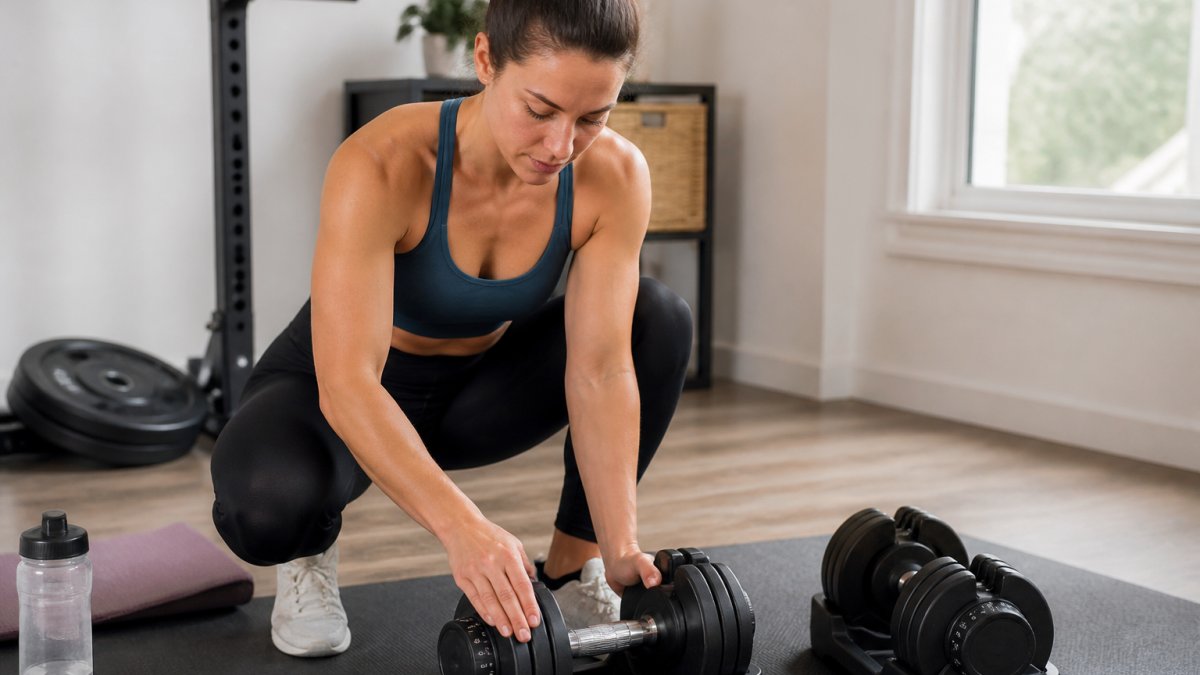
The main advantage is versatility per dollar and per square foot. You get beginner-to-intermediate loading in one purchase, and progressive overload becomes a matter of turning a dial rather than buying a new pair.
The trade-offs are real. Adjustable dumbbells are bulkier in the hand than fixed ones, which can feel awkward on certain movements.
Safety and Failure Risks by Adjustment Design
Adjustment design drives both safety and durability. Dial and selector-pin systems lock plates into the handle, and a missed lock is the most common failure point.
Inspect the locking mechanism before every session. A plate that shifts mid-press is a genuine injury risk, and it's the one failure mode that turns a bargain into a hazard.
How Much Weight Should Adjustable Dumbbells Have for Your Goals?
Match the maximum weight to your training goal, not your ego. Beginners doing general strength work rarely need more than 25 pounds per hand to start.
Weight increments matter as much as the ceiling. Small jumps of 2.5 to 5 pounds let you progress gradually, which is how strength actually builds. A set that jumps 10 pounds at a time forces you to stall or overshoot.
| Training Goal | Suggested Max Per Hand | Ideal Increment |
|---|---|---|
| Beginner general fitness | 25 lb | 2.5-5 lb |
| Intermediate muscle building | 50 lb | 2.5-5 lb |
| Advanced strength training | 70-90 lb | 5 lb |
Best Adjustable Dumbbells 2026: What to Look For Before You Buy
The best adjustable dumbbells in 2026 balance weight range, adjustment speed, grip, and build quality.
Start with the adjustment mechanism. Dial systems change weight fastest, selector pins are reliable and simple, and spin-lock collars are the most affordable but slowest. Then check the handle: a knurled steel grip beats smooth plastic for heavy loads, and a comfortable diameter reduces hand fatigue.
Adjustment Mechanism, Grip, and Build Quality
Build quality separates sets that last a decade from ones that fail in a year. Look for metal internal components over plastic, a warranty that covers the mechanism, and replacement parts you can actually buy. Repairability is the quiet factor most buyers ignore until a pin snaps.
Long-Term Cost: Adjustable Dumbbells vs Gym Membership and Fixed Weights
Most roundups tell you adjustable dumbbells "save money" and stop there. That's not an answer, it's a slogan. The real question is at what point a single adjustable purchase overtakes the recurring cost of a membership, and how it stacks against buying fixed weights one pair at a time. Here's the framework, with the math you can run against your own local prices.
The Break-Even Calculation
The comparison only works if you normalize to a monthly figure. Take the total you'd spend on a path, divide by the number of months you'll realistically use it, and compare.
- Gym membership: A typical mid-tier membership runs roughly $30-$60 per month, plus a joining fee at many clubs. Over 24 months that's $720-$1,440, and it never stops. Cancel and the asset is gone.
- Adjustable dumbbells: One pair covering roughly 5-50 lb per hand commonly lands in the $300-$600 range depending on brand and mechanism, plus an optional stand. That's a one-time outlay. Divide $450 by 24 months and you're at about $19/month, and the set still exists in month 25.
- Fixed dumbbell set: Buying 5-50 lb in 5 lb increments means ten pairs. Even at a modest average of $40-$60 per pair, that's $400-$600 before you buy a rack, and the rack itself can run $150-$400. You also pay for every weight whether you touch it or not.
Run the break-even explicitly: if an adjustable pair costs $450 and your membership is $45/month, you break even at 10 months. Every month after that is money the membership would have consumed.
What the Math Misses
Break-even on paper isn't the whole story, and this is where most guides get lazy.
- Utilization rate. A membership you use twice a month costs $22.50 per session at $45/month. An adjustable set you use twice a month costs the same $450 whether you train or not, but the per-session cost falls every time you pick it up. The set rewards consistency; the membership punishes inconsistency.
- Opportunity cost of space. Fixed racks and full sets consume floor area that has real value in a small home. Adjustables collapse that footprint to a stand or a shelf.
- Recurring add-ons. Memberships often bundle classes, childcare, and machines you may not use. If you only ever touch free weights, you're subsidizing amenities you ignore.
- Resale. Adjustable dumbbells hold resale value better than most people assume, especially models with available replacement parts. A set you paid $450 for can often be resold for a meaningful fraction of that, which lowers your true net cost. Fixed dumbbells also resell, but moving a full rack is a hassle that suppresses what buyers will pay.
The Commitment Variable
The single biggest swing factor isn't price, it's whether you'll actually train at home. If you thrive on classes, coaching, and the social pull of a gym floor, the membership math wins regardless of what the spreadsheet says.
A practical test: track how many times you actually trained in the last 30 days. Multiply that by your per-session membership cost. If the number embarrasses you, the break-even argument for a home set gets stronger fast.
For a longer view on strength training fundamentals, the CDC physical activity guidelines outline how much weekly activity adults need. The American Council on Exercise also publishes guidance on safe resistance training progression.
Who Should Not Buy Adjustable Dumbbells
Most guides are afraid to talk you out of a purchase. That's a disservice, because adjustable dumbbells are genuinely the wrong tool for several buyer profiles. If you recognize yourself below, save the money.
Heavy Lifters Who Need Loads Beyond the Ceiling
If your working sets on presses, rows, or squats routinely exceed roughly 90 lb per hand, adjustable dumbbells become a liability rather than a solution. The highest-capacity consumer sets top out in that range, and the ones that reach it are bulkier, slower to adjust, and more expensive. Beyond that ceiling you're looking at specialty adjustable systems or a barbell setup, not a dial-based pair.
High-Volume and Circuit Trainers
If your programming depends on supersets, drop sets, or timed circuits where you move between exercises every 30-60 seconds, changeover time is the dealbreaker. Dial and pin systems are fast by adjustable standards, but they're still slower than grabbing a different fixed pair off a rack. Over a 45-minute circuit session, that friction compounds into a meaningfully worse workout.
Shared Households With Mismatched Needs
A single adjustable pair is a bottleneck when two people train at the same time with different loads. One person dialing in 20 lb while the other needs 45 lb means someone waits. If your household has two regular lifters on different programs, you likely need two sets, which erases much of the cost advantage, or a fixed rack that lets both of you grab and go.
Anyone Who Wants Zero Maintenance
Adjustable dumbbells have moving parts: selector pins, dials, springs, collars, and plate interfaces. Those parts wear, and they can fail. Fixed cast dumbbells are about as close to indestructible as fitness equipment gets. If you want to buy once and never think about your equipment again, fixed weights are the honest answer.
Buyers Who Won't Use Replacement Parts
Here's the quiet disqualifier most guides skip: a set is only as durable as its parts supply. If a selector pin snaps or a plate cracks and the manufacturer doesn't sell spares, your $400 set becomes scrap. Before buying, confirm that replacement plates, pins, and handles are actually available for purchase, not just covered under a warranty you'll have to fight to use.
Apartment Dwellers With Noise and Floor Constraints
If you live above a neighbor, consider how the set behaves when a plate is set down or a mechanism is cycled. Adjustables are generally quieter than dropping fixed dumbbells, but plate rattle and the clack of a dial engaging are real. You'll also want a mat or platform to protect flooring, and you should confirm your building's rules on equipment noise before committing.
The Honest Recommendation
Adjustable dumbbells are excellent for the buyer they're built for: a solo home lifter with limited space, moderate loading needs, and the patience to change weights between sets. They're a poor fit for heavy lifters, circuit trainers, shared households with divergent needs, and anyone who wants equipment they never have to think about.
Conclusion: Making the Call on Adjustable Dumbbells
Adjustable dumbbells are worth it if you train at home, value space, and want one pair that grows with your strength. They're not worth it if you need maximum loads, zero maintenance, or fast transitions.
If you're ready to build a home setup that fits your goals, JordanWellnessCo curates fitness gear, supplements, and self-care essentials in one place.
Frequently Asked Questions
Are adjustable dumbbells worth getting in 2026?
They are worth it if you train at home, have limited space, and want a wide weight range without buying multiple pairs. Adjustable dumbbells replace an entire rack, support progressive overload, and cost less over time than a gym membership. They are not worth it if you lift very heavy, drop weights often, or prefer the feel of fixed dumbbells.
What are the downsides of using adjustable dumbbells?
The main downsides are changeover time between sets, bulkier handles than fixed dumbbells, and potential failure points in the adjustment mechanism. Some designs use plastic components that can wear out. You also need to store them carefully and check the locking system before every set. If you train fast or drop weights, fixed dumbbells may serve you better.
How much weight should adjustable dumbbells have?
Match the maximum weight to your strongest lift. Beginners often do well with 50 pounds per dumbbell, intermediate lifters usually need 50 to 90 pounds, and advanced lifters should look for 90 pounds or more per hand. Buy for where you will be in a year, not where you are today, so you do not outgrow the set.
Are adjustable dumbbells durable enough for everyday use?
Quality adjustable dumbbells hold up to daily home use if you set them down with control and keep the mechanism clean. Durability depends on the adjustment design: metal-on-metal systems last longer than plastic dials. Check the warranty, replacement part availability, and whether the manufacturer sells individual components before you buy.
Consult a qualified fitness or healthcare professional before starting a new strength training program, especially if you have an injury or medical condition.


