

Table of Contents
- Why Your Body Needs Natural Stress Relief
- Supplements for Stress Relief: What Actually Helps
- Breathing Exercises for Anxiety You Can Do Anywhere
- Physical Activities to Lower Cortisol
- Sleep Hygiene and Caffeine: The Two Levers Most People Ignore
- Digital Detox and Sensory Grounding Techniques
- Building a Routine That Sticks
- Conclusion
- Frequently Asked Questions
Last Updated: September 22, 2026
Why Your Body Needs Natural Stress Relief
Natural ways to reduce stress work because they address the root of the problem: a nervous system stuck in overdrive. This guide from JordanWellnessCo breaks down seven daily habits that calm that response without a prescription. The American Psychological Association's stress survey describes how chronic stress keeps cortisol levels elevated, which wears down sleep, mood, and focus over time. Deep breathing, movement, and sleep hygiene all speak directly to that system. Below, we'll show you exactly how to build these habits into a normal week.
Supplements for Stress Relief: What Actually Helps
Supplements for stress relief work best as a support layer, not a replacement for daily habits. The two most common categories are adaptogens and magnesium, and both have a long history of use for calming the body's response to occasional stress.
A common mistake is buying five bottles at once and never knowing which one helped.
Adaptogens and Magnesium: The Core Stack
Adaptogens are herbs that help the body adapt to everyday stress. Ashwagandha is the most familiar example, and it shows up in capsules, gummies, and even wearable patches.
Breathing Exercises for Anxiety You Can Do Anywhere
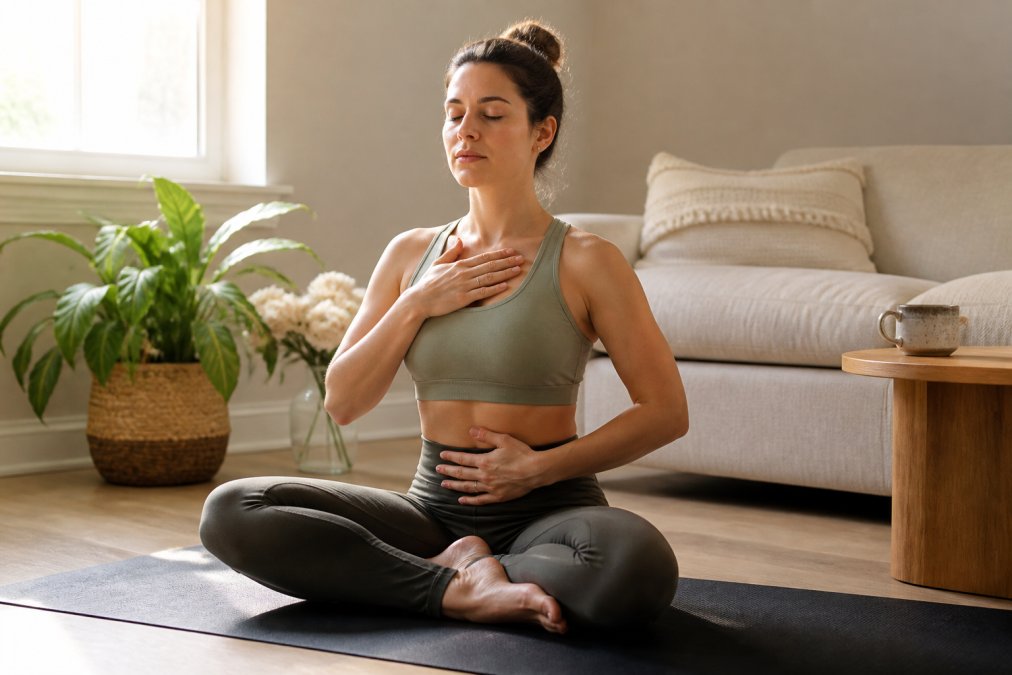
Breathing exercises for anxiety are the fastest lever you have, because they work in minutes and need no equipment. Slow, extended exhales signal safety to the nervous system, which is why these techniques show up in nearly every stress management protocol.
Box Breathing and the 4-7-8 Method
Box breathing follows a four-count pattern: inhale for four, hold for four, exhale for four, hold for four. Repeat for four rounds. It is easy to remember and works at a desk, in a car, or before a difficult conversation.
Physical Activities to Lower Cortisol
Physical activities to lower cortisol do not need to be intense, but they do need to be matched to what your nervous system can actually absorb that day. The mechanism is straightforward: movement burns off circulating stress hormones, triggers endorphin release, and gives the body a clear "threat resolved" signal through the completion of a physical task. The goal is consistency, not exhaustion.
Reading Your Own Stress Markers First
Before you pick an activity, it helps to know which state you are in. Most practitioners find that people fall into two rough camps, and the right workout is different for each:
- Wired and tense: racing heart at rest, tight jaw or shoulders, shallow breathing, trouble falling asleep. This is a high-arousal state, and hard training tends to push it higher.
- Depleted and flat: low motivation, heavy limbs, poor focus, waking up tired. This is a low-arousal state, and gentle movement often lifts it faster than rest does.
Matching the Activity to the State
| State | Best Activity | Duration | Why It Works |
|---|---|---|---|
| Wired and tense | Brisk walk outdoors, easy swim, restorative yoga | 20-40 minutes | Low intensity clears stress hormones without adding more |
| Depleted and flat | Light strength work, dancing, a short hike | 15-30 minutes | Raises energy and mood without draining reserves |
| Short on time | 5-minute walk or stair climb | 5 minutes | Breaks the stress loop and resets attention |
High-intensity training has its place, but it also raises cortisol in the short term. If you are already wired and sleeping poorly, a hard session can make the next night worse. Walking is underrated for exactly this reason.
The Workplace Micro-Break Protocol
Most stress advice assumes you have a free afternoon. If you work at a desk, the realistic version is a five-minute reset you can run between meetings. Try this sequence once in the late morning and once in the mid-afternoon:
- Stand up and walk to a window or outside for two minutes.
- Do four rounds of box breathing (inhale four, hold four, exhale four, hold four).
- Roll your shoulders and neck slowly for thirty seconds.
- Drink a full glass of water before you sit back down.
Sleep Hygiene and Caffeine: The Two Levers Most People Ignore
Sleep hygiene and caffeine intake are the two levers most people ignore, and they often matter more than any supplement. Poor sleep raises cortisol the next day, and caffeine past early afternoon keeps that cycle spinning. The reason is timing: caffeine has a half-life of roughly five to six hours in most adults, meaning a meaningful portion of a 3 p.m. coffee is still circulating at 9 p.m.
Relax & Let Go Zen Stress Patches with →
The Caffeine Cutoff
A practical rule is to stop caffeine eight to ten hours before your target bedtime. If you aim to be asleep by 11 p.m., your last coffee, tea, soda, or energy drink should land by early afternoon. People who are slow metabolizers often need the longer end of that window.
A Wind-Down Protocol That Actually Runs
The mistake most people make is treating wind-down as a vague intention. Give it a fixed sequence and a fixed start time, roughly 60 to 90 minutes before bed:
- Set a hard stop on work and screens. Dim overhead lights and switch to lamps.
- Do a brain dump. Write down tomorrow's tasks for five minutes so your mind stops rehearsing them.
- Take a warm shower or bath. The post-shower temperature drop helps signal sleep.
- Read or stretch for 20 minutes. Paper book, low light, no notifications.
- Keep the bedroom cool and dark. Most people sleep best in a cool, quiet room.
The Morning Anchor
Sleep hygiene is not only an evening project. A consistent wake time, even on weekends, is what sets the whole cycle. Get outside light within the first hour of waking when you can; morning light exposure is one of the strongest signals for a healthy sleep-wake rhythm.
Simple changes that help:
- Keep a consistent wake time, even on weekends
- Cut caffeine by early afternoon so it clears before bed
- Dim screens and lights in the last hour before sleep
- Keep the bedroom cool and dark
Digital Detox and Sensory Grounding Techniques
Digital detox and sensory grounding techniques target the two places stress hides: constant notifications and a mind that will not stop. Neither requires a retreat or a week offline.
For a digital detox, start smaller than you think:
- Turn off non-essential notifications
- Keep the phone out of the bedroom
- Set one screen-free hour in the evening
- Replace the scroll with a candle, a book, or a walk
Building a Routine That Sticks
Building a routine that sticks comes down to starting smaller than feels satisfying. Most wellness routines fail because they ask for an hour a day when you have ten minutes.
| Habit | Time Needed | Best Time of Day |
|---|---|---|
| Box breathing | 2 minutes | Any time stress spikes |
| Walk or light movement | 20 minutes | Afternoon |
| Sleep wind-down | 30 minutes | Before bed |
| Digital detox hour | 60 minutes | Evening |
| Journaling or reflection | 10 minutes | Evening |
Conclusion
Stress rarely disappears on its own, and waiting for a quiet week to start never works. JordanWellnessCo offers a curated range of supplements, fitness gear, and self-care essentials, from ashwagandha and magnesium softgels to calming candles and wearable stress patches, so you can build a routine without piecing it together from five different stores. Start with one habit and one product, and let the routine carry you from there.

Frequently Asked Questions
What is the best natural remedy for stress?
There is no single best remedy because stress responds to a combination of habits. Research points to deep breathing, regular physical activity, consistent sleep, and adaptogenic herbs like ashwagandha as effective natural approaches. Many people find that pairing a daily supplement routine with breathing exercises for anxiety produces the most noticeable change. Start with one or two habits, keep them consistent for two to three weeks, and build from there rather than trying everything at once.
What are 5 warning signs of stress?
Common warning signs include trouble falling or staying asleep, muscle tension in the neck and shoulders, irritability over small things, difficulty concentrating, and changes in appetite. Some people also notice headaches, digestive discomfort, or a racing heart. These are physical symptoms of chronic stress, and they often build gradually. If you notice several at once, that is a signal to check in with a healthcare provider and look at your daily habits, including caffeine intake and sleep hygiene.
Can lifestyle changes effectively reduce chronic stress?
Yes. Lifestyle modifications such as regular physical activity, a balanced diet, consistent sleep, and time management with clear boundaries are the foundation of stress management. A holistic approach that combines these daily habits with practices like journaling, social support, and mindfulness tends to work better than any single change. Supplements for stress relief can support that foundation, but they work best alongside lifestyle changes rather than as a replacement for them.
What are some good stress relief products?
Useful options include wearable patches with ashwagandha and L-theanine, magnesium and ashwagandha softgels, reishi gummies with lemon balm and passion flower, and aromatherapy candles for wind-down routines. At JordanWellnessCo, the Relax & Let Go Zen Stress Patches ($38.97) and the Magnesium + Ashwagandha Liquid Softgels ($49.97) are popular starting points. Pair any product with breathing exercises and a consistent sleep schedule so the effect builds over time instead of relying on one item alone.


